Do I Need a Dehumidifier in Florida?
Yes, most Florida homes benefit from a dehumidifier, especially in summer when outdoor humidity sits near 95% and indoor air can climb past 60%. A unit sized to the room keeps humidity in the 45% to 55% range without overcooling.
On this page (9 sections)
- Why Florida humidity is a different problem
- What indoor humidity level should you target in Florida?
- Which rooms in a Florida home need one most?
- How do you size a dehumidifier for a Florida home?
- The best overall pick for a Florida home
- A smaller pick for one room or a modest home
- Setting up a dehumidifier in Florida's climate
- Common mistakes Florida buyers make
- How to decide whether to buy one
Yes, most Florida homes benefit from a dehumidifier. Outdoor humidity sits near 95% on a summer afternoon, and that moisture finds its way inside through doors, windows and the building shell.
A dehumidifier is the tool that pulls it back out when your AC is not running enough to do the job. Whether you actually need one comes down to your rooms, your AC and how the air feels.
This guide walks through the decision so you can size and choose a unit with confidence. If you want the short version first, read our how to tell if you need a dehumidifier checklist.
Why Florida humidity is a different problem
Florida's humidity is high almost year round, and the state's climate makes it one of the hardest places in the country to keep indoor air dry. Relative humidity outdoors often runs 70% to 95%, and warm air holds far more water than the same air would up north.
That moisture is what makes a 78°F room feel sticky and what feeds mold on drywall, closets and furniture.
The tricky part is that your air conditioner is a dehumidifier too. It removes water as it cools, so in the hottest months a well-maintained central system usually holds indoor humidity near 50%.
The problem comes when the temperature drops but the moisture stays. In spring, fall and winter warm spells, the AC cycles off while the air is still damp.
Coastal areas feel this most, where sea breezes push moist air in even on mild days.
When your AC stops keeping up
Watch for the signs that the cooling system has stopped controlling moisture. Condensation on windows and glass doors, a clammy feel at a normal thermostat setting, musty smells in closets and slow-drying towels all point the same way.
Those are the moments when a dehumidifier earns its place. The rest of the year it may sit idle, but during humid shoulder seasons it keeps the house livable without dropping the temperature.
A dehumidifier is not a replacement for AC, but it fills the gap the AC leaves. That is the whole case for owning one in Florida.
What indoor humidity level should you target in Florida?
Aim for 45% to 55% relative humidity indoors. That range is comfortable for people and dry enough to make mold less likely to get started.
Above 60% is where mildew, dust mites and musty odors thrive, and Florida air sits in that band often enough to matter.
Your target does not need to be lower than 45%. Very dry air feels uncomfortable, dries out wood furniture and wastes energy.
The goal is to stay inside the band, not to chase the lowest number your unit can reach. A unit with an adjustable humidistat lets you set the target and forget it, so the compressor cycles only when needed.
Measuring before you buy
You cannot manage what you do not measure. A cheap hygrometer takes the guesswork out of the decision and shows you exactly where each room sits.
Place one in the room you suspect most, let it log for a few days, and compare the readings to the 45% to 55% band. If a room sits above 60% for hours at a time, that is your answer.
The Govee H5075 reads temperature to ±0.54°F and humidity to ±3%RH, and its app keeps 20 days of history you can export. That history matters in Florida because the worst humidity often shows up at night or when the house is empty.
Mount it away from vents and direct sun so the readings reflect the room. The Bluetooth connection reaches about 164 ft in open air.
Measure first, then decide. A hygrometer costs far less than a dehumidifier and tells you whether the problem is real.
Which rooms in a Florida home need one most?
The dampest rooms need a dehumidifier first, and in Florida those are usually the garage, lanai, laundry room and any finished space below grade. Each one collects moisture differently, so the right unit changes room by room.
Whole-house humidity is best left to the AC, while a dehumidifier shines in a single problem area.
Garages are the classic case. They are not air conditioned, the door opens to humid outdoor air all day, and tools, bikes and stored boxes sit in that damp.
A lanai or screened porch has the same exposure and often grows mildew on furniture and screens. A laundry room adds dryer moisture on top of the ambient humidity.
Finished basements are rare in Florida, but where they exist near the water table they stay damp all year.
Matching the unit to the room
Small rooms like a bedroom or closet may only need a compact 20 to 35 pint unit. A two-car garage or a large basement calls for a bigger compressor model.
If the space is air conditioned and cool, a desiccant unit works better because it does not rely on a cold coil. Our guide on compressor vs desiccant dehumidifier explains which type fits each room, and it is worth reading before you commit.
Pick the room, then pick the type. Buying one big unit for the whole house rarely works as well as targeting the room that actually feels damp.
How do you size a dehumidifier for a Florida home?
Match pints per day to square footage, then add a margin for Florida's climate. A 50 pint unit covers about 4,500 sq ft and an 80 pint unit covers up to 5,500 sq ft.
Those ratings assume warm, humid conditions, which is exactly what Florida delivers, so the numbers hold up well here.
Sizing up a step is smart in the Sunshine State. A unit that runs at part capacity uses less energy and lasts longer than one working flat out.
If you are between two sizes, choose the larger one for a whole-floor application and the smaller one for a single sealed room. The pint rating matters more than tank size, since you can drain continuously with a hose.
Reading the pint rating correctly
The pint figure is how much water the unit pulls from the air in 24 hours under standard test conditions. In Florida's warm air a compressor model hits that number more easily than it would in a cool northern basement.
An 80 pint model rated for a hot, humid day at 95°F and 95%RH is a realistic fit for a large Florida home. That is why Florida buyers can trust the headline rating more than shoppers in drier states.
Size for your wettest week, not your average. A unit that keeps up in July will handle the rest of the year without strain.
The best overall pick for a Florida home
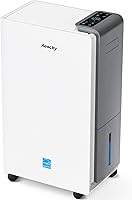
For most Florida homes the AEOCKY 80 Pint 5,500 Sq Ft Dehumidifier is the best overall choice. It carries an ENERGY STAR Most Efficient 2025 rating, which only 2.6% of ENERGY STAR models earn, and its 80 pint daily capacity covers a large open floor, a garage or a whole basement.
AEOCKY says the RHEA-001 removes 80 pints per day at 95°F and 95%RH and 56 pints in an 86°F basement at 80%RH. It uses a rotary compressor with a "3+2" evaporator and condenser structure and pure copper tubing, and the brand claims efficiency up to 50% better than non-Energy Star models.
A drain hose and garden hose adapter come in the box, so you can run it continuously without emptying the 1.45 gallon tank. The lowest fan speed runs at 44dB.
This is the unit to buy when you want one machine to handle a big Florida space and you plan to leave it running. It suits a garage, a large basement or an open living area where the AC struggles.
If your problem is a single bedroom or a closet, a smaller unit is the smarter buy. The score of 9.2 reflects its top-tier efficiency, capacity and coverage.
A smaller pick for one room or a modest home
The Midea 50 Pint Dehumidifier is the better fit for a single room or a modest home where 80 pints would be overkill. It removes 50 pints per day and covers up to 4,500 sq ft, with an adjustable humidity setting from 35% to 85%.
That range lets you set a Florida-friendly 50% and let the unit manage itself.
Midea's unit runs at 49 dBA on its low setting, which is quiet enough for a bedroom or home office. Wi-Fi control through the SmartHome app means you can adjust it from anywhere, and Alexa and Google Assistant voice commands work too.
A standard hose (not included) connects to the built-in socket for continuous draining, and the unit stops automatically when the tank fills. Four rotating wheels and handles make it easy to move between rooms.
The score of 8.2 reflects its smaller coverage and lighter feature set compared with the AEOCKY.
Choose this one when your damp problem lives in a bedroom, a small basement or a single living area. It also suits a condo where an 80 pint cabinet would dominate the room.
If you want continuous draining without buying a hose, the best dehumidifiers with a hose drain roundup covers models that include one.
Setting up a dehumidifier in Florida's climate
Run the unit in the dampest room, set to 50%, and drain it continuously if you can. Placement and drainage decide how well any dehumidifier performs in Florida, more than the brand name on the box.
A few setup choices make the difference between a machine that works and one you fight all summer.
Keep the unit a few inches from walls and clear of furniture so air can flow through it. Close windows and doors in the room while it runs, or you will pull in fresh humid air as fast as the unit dries it.
In a garage, keep the big door closed during the heat of the day. Empty or drain the tank before it fills, and use a hose for continuous operation so the unit does not shut off overnight.
Clean the filter every couple of weeks in summer, since Florida dust and pollen load it quickly.
Running it with your AC
Let the AC handle the hot months and bring in the dehumidifier when the air feels sticky but the thermostat is satisfied. Set the dehumidifier to 50% and leave it.
Running both at once in the same room wastes energy; in a whole house, put the dehumidifier where the AC is weakest.
Set it and leave it. A dehumidifier on a hose drain at a fixed 50% target runs quietly in the background and needs little attention beyond filter cleaning.
Common mistakes Florida buyers make
The most common mistakes are buying too small and skipping the drain hose. Both cost more in the long run than getting the setup right the first time.
Florida's humidity is unforgiving, so a unit that is slightly oversized and drained continuously will serve you better than a perfectly matched one you have to babysit.
Oversizing for a single room
Bigger is not always better. An 80 pint unit in a small bedroom dries the air fast and then cycles on and off, which is noisy and wasteful.
For one room, a 20 to 35 pint unit or a 50 pint model set low is the better match. Save the large units for open floors and garages.
Forgetting the drain
Emptying a tank every few hours in peak summer is the fastest way to stop using a dehumidifier. A hose drain turns the job into a set-and-forget appliance.
Check that your chosen spot is near a floor drain, a sink or a window you can run the hose to. The dehumidifier for home roundup lists room-by-room options if you are still deciding.
Ignoring the type of space
A cool, air-conditioned room and a hot garage need different machines. A compressor unit in a 60°F space frosts up and stops working.
Match the type to the room's temperature before you buy. Running the wrong type is a bigger mistake than picking the wrong size.
Avoid these three and you will get years of use from one purchase.
How to decide whether to buy one
Buy a dehumidifier if any room in your home reads above 60% humidity for hours at a time, or if you see condensation, musty smells or mildew. Skip it if your AC already holds the whole house at 45% to 55% and no room feels damp.
Most Florida homes fall somewhere between those two, and the hygrometer tells you which side you are on.
Your next step is simple. Put a hygrometer in the room you suspect most and watch it for a few days.
If it stays high, choose a compressor unit sized to that room and set it to 50%. If the room is cool and sealed, a desiccant unit is the better call.
The AEOCKY 80 pint is the pick for a large damp space, and the Midea 50 pint covers a single room or a smaller home. So, do you need a dehumidifier in Florida?
For most homes with a damp garage, lanai or bedroom, yes, and measuring first tells you exactly where to put it.
Frequently asked questions
Do I need a dehumidifier in Florida if I run the AC?
Yes in many cases. A central AC removes moisture while it cools, but it only runs when the temperature calls for it.
In mild weather or empty rooms, humidity can climb while the AC sits idle, so a dehumidifier fills that gap.
What indoor humidity is too high in Florida?
Above 60% relative humidity is where mold and mildew get a foothold. Aim for 45% to 55% indoors.
Your AC may hold that in hot weather, but a dehumidifier is what keeps it there during the humid shoulder seasons.
How many pints per day do I need for a Florida home?
Match pints to square footage. A 50 pint unit covers about 4,500 sq ft and an 80 pint unit covers up to 5,500 sq ft.
For a single humid room like a garage or bedroom, a smaller 20 to 35 pint model is enough.
Is a compressor or desiccant dehumidifier better in Florida?
A compressor model suits most Florida homes because warm air lets the coil work efficiently and it uses less power. A desiccant unit is the better call for a cool space under 65°F, like a sealed crawlspace or an air-conditioned garage in winter.
Will a dehumidifier make my Florida house cooler?
Slightly. A compressor dehumidifier blows warmer, drier air, so it takes the sticky edge off without chilling the room.
The real comfort gain is lower humidity, which lets your AC feel effective at a higher thermostat setting.
Where should I put a dehumidifier in a Florida home?
Put it in the dampest room, not the coldest. Garages, lanais, laundry rooms and finished basements under the water table are common spots.
Keep it a few inches off the wall and use a hose drain so you are not emptying a tank every day.