Midea 50 Pint Dehumidifier Review: Worth It? (October 2026)
This Midea 50 pint dehumidifier review finds a strong fit for large rooms where Wi-Fi control and tank-or-hose drainage are useful. Choose another model if you need a hose in the box or a stated low-temperature limit.
On this page (11 sections)
- What does this Midea 50 pint dehumidifier review recommend?
- How should you match the Midea to your room?
- Will the tank or hose work better for your routine?
- What do Wi-Fi and voice controls add?
- How should you set up and care for the Midea?
- What mistakes can make a dehumidifier less useful?
- Which 50-pint alternative fits a different need?
- What should you check before buying?
- How much electricity will a 50-pint dehumidifier use?
- Which dehumidifier should you choose?
- How we scored these dehumidifiers
The Midea 50 pint dehumidifier review verdict is straightforward: this model suits a large room where app control and flexible drainage are priorities. It removes up to 50 pints per day, has stated coverage of 4,500 sq ft, and lets you choose between its tank and a separately supplied hose.
The 1.6-gallon tank is much smaller than its daily moisture-removal capacity. In damp conditions, expect to empty it regularly unless you set up continuous drainage.
What does this Midea 50 pint dehumidifier review recommend?
The Midea is a good match for large, connected living areas where remote control and adjustable humidity settings are useful. It may be a poor fit if you need a hose included, a stated cold-room operating limit or a larger tank.
Midea 50 Pint Dehumidifier: Best for app control

- Up to 50 pints per day
- Wi-Fi and voice control
- 1.6-gallon tank or hose drainage
A large-capacity Midea with app and voice control, adjustable humidity settings, and a built-in connection for a standard hose.
Pros
- Wi-Fi control through the SmartHome app
- Works with Alexa and Google Assistant
- Tank-full shutoff
- Wheels and handles for moving between rooms
Cons
- Standard hose is not included
- A 1.6-gallon tank can call for regular emptying
- Coverage depends on room size and climate
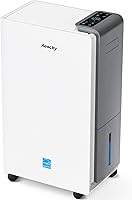
The unit has a digital control panel, handles and four rotating wheels for moving it between rooms. Its adjustable humidity range is 35% to 85%; the product description recommends keeping indoor humidity around 45% to 55%.
Who should choose the Midea 50 pint dehumidifier?
Choose it if the damp area is large, you want Wi-Fi and voice controls, and you can either empty the tank or arrange a drain hose. The app and assistant support can be convenient when the unit is placed out of sight.
Skip it if your room stays cold and you need confirmed low-temperature operation. The Midea's product information does not give a minimum operating temperature, while the Hisense is rated for operation down to 38°F.
How should you match the Midea to your room?
Treat the stated 4,500 sq ft coverage and 50-pint daily capacity as selection guides, not a promise that one unit will manage every space of that size. Room temperature, moisture sources, air movement and layout all affect how quickly a dehumidifier can lower humidity.
Start by measuring the area you want to dry and noting whether doors separate it into smaller rooms. A single open basement is different from several rooms with closed doors, even if their combined floor area is the same.
Pint ratings also depend on the conditions used to measure capacity. Our guide to dehumidifier pint ratings explains what the number can tell you and why two units with the same rating may not behave alike in your home.
If you are choosing between a 50-pint unit and a larger model, compare the size and moisture level of the space rather than buying by coverage number alone. Our large basement dehumidifier guide covers options for bigger or persistently damp areas.
Will the tank or hose work better for your routine?
The Midea gives you a 1.6-gallon tank or continuous drainage through a standard hose connection. It stops when the bucket fills and restarts after the tank is emptied.
The tank can fill before a long run is over, especially when the air is very damp. If you won't be nearby to empty it, a hose can cut down on interruptions, but it needs a safe path to a drain.
The hose is not included. Before setup, measure the distance to the drain and check that the hose can run downhill without sharp bends or places where water could pool.
A hose also needs occasional attention. Check that it remains connected and clear.
Look for leaks after moving the unit or changing its position. If hose drainage is central to your decision, see our guide to dehumidifiers with a drain hose.
What do Wi-Fi and voice controls add?
Wi-Fi control lets you use the SmartHome app on iOS or Android, and the unit supports Alexa and Google Assistant voice commands. These controls are useful when you want to adjust the unit from another room or check settings without walking to the panel.
Set the humidity target for the space, then give the room time to respond. A setting that works during a humid summer may not suit a cooler, drier season.
The app does not replace basic upkeep. Keep the air filter clean and empty the tank when needed.
Leave room around the unit so air can circulate. For help choosing a target, read our advice on a good humidity level for a house.
How should you set up and care for the Midea?
Place the dehumidifier on a level floor with its air intake and outlet clear. Leave enough access to reach the controls, filter and tank, and avoid wedging it behind stored items or furniture.
If you plan to use the tank, check it regularly at first to learn how quickly it fills in your room. Empty it before it reaches capacity, and make sure it is seated correctly when you put it back.
For continuous drainage, attach a suitable standard hose to the built-in socket and direct the other end to a drain. Keep the route sloping downward, then check that water is flowing and that the connection is secure.
The washable air filter is designed to capture dust. Check it as part of routine care, and clean it when it needs attention so dust does not build up and restrict airflow.
What mistakes can make a dehumidifier less useful?
A common mistake is choosing a model by its maximum coverage figure without checking the room layout. Closed doors, separate floors and ongoing moisture sources can limit how well one portable unit serves a whole area.
Another is relying on the tank while expecting uninterrupted operation. The Midea shuts off when the tank fills, so use the hose connection if you want continuous drainage and can route it safely.
Don't place the unit where air cannot move freely, or where you cannot reach the bucket and filter. Also avoid setting a humidity target and then assuming it will suit every season; check the room's conditions and adjust as needed.
For a basement with a musty smell, lowering humidity can help address damp conditions, but it does not remove mold or fix a water leak. Our guide to getting rid of a musty smell in a basement covers other steps to consider.
Which 50-pint alternative fits a different need?
The best alternative depends on whether compact dimensions, filter care or cooler-room operation matter more than Wi-Fi control. Each model below is rated at up to 50 pints per day, but their practical features differ.
| Model | Stated coverage | Standout detail |
|---|---|---|
| AEOCKY 50 Pint Quiet Dehumidifier | 3,500 sq ft | Compact dimensions and included drain hose |
| Midea 50 Pint Dehumidifier | 4,500 sq ft | Wi-Fi and voice control; 1.6-gallon tank |
| Frigidaire 50 Pint Wi-Fi Dehumidifier | 4,500 sq ft | Washable filter and custom humidity control |
| Hisense 50 Pint Portable Dehumidifier | 4,500 sq ft | Operation down to 38°F |
AEOCKY 50 Pint Quiet Dehumidifier: Best for tight floor space

- Up to 50 pints per day
- 3,500 sq ft coverage
- Included drain hose
A compact 50-pint option with an included drain hose and a small tank, suited to spaces where footprint matters.
Pros
- Included 2 m drain hose
- Compact dimensions
- Three-year machine warranty
Cons
- Smaller 0.8-gallon tank
- Coverage is lower than the Midea's stated area
AEOCKY is the alternative for tighter floor space and a hose-ready setup. It includes a 2 m drain hose, but its tank is 0.8 gallons, half the Midea's stated tank volume.
Frigidaire 50 Pint Wi-Fi Dehumidifier: Best for washable-filter care

- Up to 50 pints per day
- Washable filter
- Custom humidity control
A 50-pint alternative with custom humidity control and a washable filter designed to capture dust.
Pros
- Washable filter
- Custom humidity control
- Continuous-drain feature
Cons
- No tank volume is stated
- The Wi-Fi function is not described in detail
Frigidaire makes sense if washable-filter care is high on your list. It also offers custom humidity control and continuous drainage, though a tank volume is not specified.
Hisense 50 Pint Portable Dehumidifier: Best for cold basements

- Up to 50 pints per day
- Operation down to 38°F
- Three modes and fan speeds
A 50-pint option for cooler basements and crawl spaces, with three operating modes and three fan speeds.
Pros
- Operates down to 38°F
- Auto, Continuous, and Manual modes
- Three fan speeds
Cons
- No Wi-Fi control is stated
- Tank volume is not clearly specified
Hisense is the clearest fit for a cooler basement or crawl space because its stated operating range reaches down to 38°F. It has Auto, Continuous and Manual modes, plus three fan speeds.
What should you check before buying?
Measure the space where the unit will stand and make sure you can reach its bucket and controls. The Midea measures 11.1 in deep, 15.43 in wide and 24.25 in high, and weighs 41.2 lb.
Plan drainage before you bring it into the room. If you will use the bucket, decide how often you can check and empty it; if you will use a hose, make sure a suitable drain is close enough.
Consider noise and placement if the unit will run near a bedroom or work area. Midea gives a low-mode level of 49 dBA and a high-mode figure of 54 dBA, so think about when you expect it to run and which speed you will use.
Check the temperature in a basement or crawl space during the coldest part of the year. If that space gets cold, the Hisense's stated 38°F operating limit may make it a more suitable option.
How much electricity will a 50-pint dehumidifier use?
The Midea's pint rating does not tell you its electricity use. To estimate running costs, check the unit's wattage and multiply it by the hours it runs, then use your electricity rate.
Run time changes with room humidity, temperature, the selected setting and moisture entering the space. Keeping doors and windows closed while the unit runs can reduce the amount of humid air it has to treat.
Our guide to dehumidifier electricity use explains how to make a basic estimate from wattage and operating time. Compare the exact model's energy information if power use is a major factor in your choice.
Which dehumidifier should you choose?
Choose the Midea if you want remote control, adjustable humidity settings and the flexibility to use a tank or a hose in a large room. Skip it if you need an included hose, a published cold-weather limit or a larger tank.
Pick the AEOCKY if a compact footprint and included hose matter most. Choose the Frigidaire for a washable filter, or the Hisense if the room gets cold.
For another Midea option with a different design and capacity, compare our Midea Cube 20 Pint review. This Midea 50 pint dehumidifier review points to the standard 50-pint model for large spaces where app control and drainage choice matter more than cold-room operation.
How we scored these dehumidifiers
Our scores reflect how each model's stated features fit the needs of someone comparing large-room dehumidifiers. We considered capacity, drainage, controls, maintenance and operating details, with the Midea's remote controls balanced against its smaller tank and separately supplied hose.
Brand claims about coverage and noise can vary with room conditions and placement. Match the unit to the space and drainage routine you can manage.
Frequently asked questions
Is the Midea 50 Pint Dehumidifier good for a basement?
It can suit a large basement, with stated coverage of 4,500 sq ft and removal of up to 50 pints per day. Room size, layout and climate affect results.
Use a hose for continuous drainage if you don't want to empty its 1.6-gallon tank.
Can you control the Midea 50 Pint Dehumidifier remotely?
Yes. It connects to Wi-Fi and works with the SmartHome app on iOS or Android, plus Alexa and Google Assistant voice commands.
Remote control can help when the unit sits in a basement or another room you don't visit often.
Check that your preferred assistant and home network meet your needs.
Does the Midea 50 Pint Dehumidifier include a drain hose?
No standard hose is included. The Midea has a built-in socket for a standard hose, which you can connect for continuous draining.
You can also empty the 1.6-gallon tank by hand.
Before buying a hose, confirm it fits the connection and can reach a suitable drain without kinks or uphill sections.
How quiet is the Midea 50 Pint Dehumidifier?
Midea gives a low-mode sound level of 49 dBA and a high-mode figure of 54 dBA. The unit has three speeds, so you can choose a lower setting when noise matters.
Think about where it will run and how close it is to a bed, desk or television.