How Much Can a Dehumidifier Lower Humidity?
A dehumidifier can typically lower a room's relative humidity by 20 to 40 percentage points, often turning a muggy 70% room into a comfortable 40–50%. How far it gets depends on room size, air leaks, temperature, and the unit's rated capacity.
On this page (11 sections)
- What humidity drop should you expect from a dehumidifier?
- How does dehumidifier capacity affect the humidity drop?
- Why does your room stop at a certain humidity level?
- What humidity level should you aim for?
- How do room size and layout change the result?
- How do temperature and outside weather affect the drop?
- What slows a dehumidifier down the most?
- How do you hold humidity down after the first drop?
- How long should it take to see a change?
- Can a dehumidifier cool the room while it dries it?
- Final answer on how far a dehumidifier can go
How much can a dehumidifier lower humidity? A typical unit pulls a room down by 20 to 40 percentage points, so a 70% basement often settles in the 40–50% range.
The exact drop depends on how much water the unit can remove per day, how big the space is, and how much damp air keeps leaking in.
That range covers most homes. A small, closed bedroom dries faster than a leaky basement, even with the same machine.
The pint rating tells you water removal per day, not the humidity drop you'll see.
What humidity drop should you expect from a dehumidifier?
Expect the biggest drop in a closed, average-sized room and the smallest in a large, open space. A 70-pint unit in a 500 sq ft sealed bedroom can hit its target in a few hours.
The same unit in a 1,500 sq ft basement with a loose door may only shave off 10 to 15 points.
Think in two stages. First the unit removes the standing moisture in the air.
Then it has to keep up with new moisture from walls, floors and outside air. The first stage is fast; the second is a long grind.
This is why how a dehumidifier works matters for your expectations. It pulls air across cold coils, condenses water out, and returns drier air.
The slower the air exchange in the room, the faster the reading falls.
How does dehumidifier capacity affect the humidity drop?
Higher pint capacity removes more water per day, so it lowers humidity faster in bigger or wetter spaces. An 80-pint unit moves about twice the water of a 40-pint unit under the same conditions.
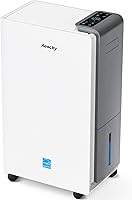
Capacity is rated at specific conditions. The AEOCKY RHEA-001 is rated at 80 pints per day in hot, humid air (95°F, 95% relative humidity) and 56 pints per day in a warm basement (86°F, 80% relative humidity).
Those ratings are the maker's figures, not a guarantee of your room's drop.
A 20-pint unit suits a closet or small bathroom. A 50-pint unit fits a typical finished basement room.
An 80-pint model makes sense when the space is large or the damp load is heavy.
Why does your room stop at a certain humidity level?
A dehumidifier stalls when new moisture arrives as fast as it leaves. That's a balance point, not a fault.
The unit runs, but the reading holds steady.
Common sources are an open window, a damp crawlspace, wet laundry, a bathroom fan venting indoors, or groundwater seeping through a basement wall. Each adds moisture the unit must fight.
Cold surfaces also matter. Below about 65°F, many compressor units frost up and defrost often, which slows removal.
The AEOCKY uses defrost sensors so it keeps running at low temperatures, though performance still drops in cold rooms.
If the reading won't budge, check the obvious first: full tank, closed windows, blocked air filter. Then look at the setpoint.
A unit set to 60% won't go lower, no matter how long it runs.
What humidity level should you aim for?
Set the target at 45% to 50% in living areas and 40% to 45% in basements. That range feels comfortable and keeps mold from getting a foothold.
Below 40% starts to feel dry for most people.
Mold generally needs sustained humidity above 60% to grow. Keeping a basement under 55% is a practical goal.
A garage or workshop can sit a little higher.
Don't chase the lowest possible number. Running a unit flat out to reach 30% wastes energy and dries the air past comfort.
A humidity control setpoint lets the machine cycle and hold steady.
The Govee H5075 makes this easy to see. It reads humidity to ±3% RH and refreshes about every 2 seconds, with a 3-inch LCD and a comfort indicator.
The app stores 20-day graphs, so you can watch a room settle after you change a setting.
How do room size and layout change the result?
Treat each closed room as its own zone. A dehumidifier conditions the air around it.
Open doors let drier air spread; closed doors trap each room's humidity.
For a whole-floor effect, place the unit centrally and leave interior doors open. In a basement, run it near the dampest corner or wall.
Avoid tucking it into a closed closet, where it just recirculates its own air.
Large open spaces need more capacity or more time. The AEOCKY's 5,500 sq ft coverage rating assumes open, connected space.
Split by walls and doors, you'll need more than one unit or more patience.
How do temperature and outside weather affect the drop?
Warm air holds more water, so a unit removes more pints when it's warm. That's why ratings quote high temperatures.
In a cool basement, expect slower progress.
Humid summer air also reloads the room every time a door opens. In that season, run the unit more and keep windows shut.
In winter, the air is drier and a dehumidifier may barely run.
Very cold rooms are the hardest case. Compressor units lose efficiency as temperatures fall.
If your space stays under 60°F, plan on longer run times or a unit built for low temperatures.
What slows a dehumidifier down the most?
Air leaks and a full tank are the two biggest slowdowns. Everything else is secondary.
Fix those first before blaming the machine.
Other drags include a clogged filter, a blocked intake, and furniture pushed against the vents. A unit in a tight corner can't pull in room air.
Give it a couple of feet of clearance.
A high setpoint is a hidden slowdown. If the target is above the current reading, the unit has nothing to do.
Confirm the setting sits below where you want the room to land.
How do you hold humidity down after the first drop?
Keep the air moving and stop new moisture at the source. A dehumidifier is a tool, not a fix for a wet wall or a leaking window.
Seal obvious gaps, fix plumbing drips, and vent the dryer and bathroom fans outside. Run exhaust fans during showers and cooking.
Our guide to how to lower humidity in your house covers the source fixes in order.
Set up a drain so the unit runs without stopping
A full tank shuts a unit off, so the humidity creeps back up. A gravity drain solves that.
The Ebusin 12 ft hose has a 3/4-inch threaded end that fits most dehumidifier outlets, with brass fittings and a rubber seal to prevent leaks.
Run the hose downhill to a floor drain or sump. Keep the fall steady, since standing water in the line can back up.
Check the connection once after setup and then leave it alone.
Pick a target and let the unit cycle
Once the room reaches 45% to 50%, leave the setpoint there. Cycling on and off uses less power than running flat out.
A unit that holds a steady level is working correctly, even if it seems to run less often.
Check the reading before you trust the result
A built-in humidistat can drift, so a separate hygrometer is the honest check. Place it away from the unit's exhaust and from outside walls.
If the two readings disagree by more than a few points, trust the standalone meter.
How long should it take to see a change?
Give it 3 to 6 hours in a closed room and up to a day for a large basement. The first hour often shows the fastest movement, as the standing moisture in the air comes out.
If nothing changes after a day, something is off. Check the tank, the drain, the setpoint, and the air leaks.
A unit that runs constantly without dropping the reading is usually fighting an open moisture path.
Can a dehumidifier cool the room while it dries it?
It cools slightly, but it's not an air conditioner. The air leaving the unit feels cooler and drier, but the motor adds some heat back.
The net effect on room temperature is small.
The bigger comfort gain comes from lower humidity. Drier air lets your skin cool more easily, so the room feels cooler even when the thermometer hasn't moved.
Our explainer on whether a dehumidifier cools a room covers what to expect.
Final answer on how far a dehumidifier can go
Plan on a 20 to 40 point drop in a closed room, with 40% to 50% as the sensible stopping point. A bigger unit gets there faster in a large or leaky space, but no unit beats an open window feeding it damp air.
Match the machine to the room: an 80-pint unit for a big damp basement, a smaller one for a bedroom or closet. Then add a separate hygrometer so you know the real number, and a drain hose so the unit doesn't shut off at the wrong moment.
That combo gets you to a steady, comfortable level and keeps it there. For the long view on the appliance itself, see how long a dehumidifier lasts.
Frequently asked questions
How long does a dehumidifier take to lower humidity?
A dehumidifier usually shows a clear change within 3 to 6 hours in a closed room, and reaches its target within a day. Larger spaces, open doors and heavy damp loads take longer.
Set it to run continuously for the first stretch, then switch to a humidity target.
Is 35% humidity too dry for a home?
Yes for most homes. Below about 40% many people notice dry skin, static and irritated sinuses.
Aim for 40% to 50% in living areas.
If a unit keeps overshooting into the 30s, raise its target setting or run it on a timer.
Does a dehumidifier lower humidity in the whole house?
Only if the air can move between rooms. A single unit treats the space it sits in, plus nearby open rooms.
With closed doors, bedrooms and upstairs areas stay at their own humidity.
Run the unit in the dampest room and keep interior doors open when you can.
Why does my dehumidifier stop lowering the humidity?
The tank is likely full, or the room is leaking humid outside air faster than the unit can remove it. Check the tank and the drain, close windows, and confirm the setpoint is below the current reading.
Cold rooms below 65°F also slow many compressor units.
Can a dehumidifier make a room too dry?
Yes, if the target is set very low or the unit runs without a humidity control. Most units let you pick a setpoint.
Keep it at 45% to 50% and let the machine cycle on and off rather than run flat out all day.