Can One Dehumidifier Do a Whole House?
Usually no, not if it's a portable unit. A single freestanding dehumidifier handles one room or one open area. One unit can dry a whole house only when it's a ducted whole-house dehumidifier tied into the HVAC system, sized to the home's square footage.
On this page (7 sections)
- Can one portable dehumidifier handle every room in a house?
- When can one dehumidifier dry a whole house?
- What size dehumidifier do you need for a whole house?
- Can one dehumidifier dry a house through open doors and fans?
- How do you measure whether one unit is enough?
- What are the signs you need a second unit or a ducted system?
- What should you do before buying a whole-house dehumidifier?
Usually no, not if it's a portable unit. A single freestanding dehumidifier handles one room or one open area.
One unit can dry a whole house only when it's a ducted whole-house dehumidifier tied into the HVAC system, sized to the home's square footage.
The short answer depends on which kind of machine you mean. A bucket-and-cord unit that rolls between rooms works fine in a basement or a large living space.
It doesn't move air between closed rooms, so bedrooms and upstairs hallways stay as damp as before.
Can one portable dehumidifier handle every room in a house?
No, a portable unit only treats the air around it. Its fan pulls in air from the room it stands in, dries it and pushes it back out.
Air in rooms behind closed doors doesn't reach the unit.
This is why a single portable unit in the basement leaves the upstairs bedrooms untouched. Moisture doesn't travel toward the dehumidifier on its own.
It stays in the room where the source is, whether that's a damp foundation, a bathroom, or a crawl space.
A portable unit works best as a room tool. You put it where the moisture is, connect a drain hose, and let it run.
That's why our list of the best dehumidifiers for a large basement focuses on room coverage and drainage rather than whole-home claims.
How big a space can one unit realistically dry?
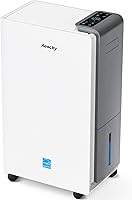
Check the square footage the maker states for the unit. An 80 pint unit like the Yaufey is rated for up to 5,500 square feet, which sounds like a whole house but usually means one open, damp area.
An open basement counts as one space. A main floor with closed bedrooms, a hall and a kitchen does not.
The rated coverage assumes air can mix freely and humidity stays within the unit's working range.
If your damp area is closer to a large open room than a maze of doors, a 70 pint dehumidifier is a sensible starting point. Measure the space and compare it to the coverage figure on the unit you're considering.
When can one dehumidifier dry a whole house?
One unit can treat the whole home when it's ducted into the HVAC system. That's the whole-house setup: the dehumidifier sits in the basement, crawl space or mechanical room and connects to the home's ducts.
Air from across the house passes through it and comes back drier. The unit runs on a humidity set point and drains continuously, so there's no tank to empty.
That's the only realistic way one machine dries every room.
The AprilAire E080W is built for this job. AprilAire says it removes up to 80 pints a day and covers homes up to 4,400 square feet.
It connects to ducts with the included 8-inch inlet and outlet collars, and it ships with a pump, drain hose, hanging kit and MERV 11 filter.
Wi-Fi control through the AprilAire Connect app lets you adjust the set point without going to the basement. For a whole-house approach, compare the options in our roundup of the best whole house dehumidifiers.
Can a whole-house dehumidifier run without ducts?
It can, but then it acts like a very large room unit. Without duct connections, it dries only the space it stands in.
The ducts are what turn one machine into a whole-house solution.
That's why installation matters more than the capacity number. A unit rated for 80 pints a day still needs a path for air from the rest of the house to reach it.
What size dehumidifier do you need for a whole house?
Match the rated coverage to the home's square footage, then check the pint capacity. For most homes up to 4,400 square feet, an 80 pint unit like the AprilAire E080W is in the right range.
Ducted units are rated by square feet and pints per day. A 2,000 square foot home needs less capacity than a 4,000 square foot one.
Damp crawl spaces and leaky basements push the requirement up.
A large open basement is a different problem. There, a portable 80 pint unit like the Yaufey can cover up to 5,500 square feet of one space.
It removes up to 80 pints a day and has a 1.06 gallon tank plus a drain hose for continuous drainage.
That makes it a good fit for a big, open basement or a large damp room. It won't push air upstairs or through closed doors.
For rooms like that, see the best dehumidifiers for a large basement and match coverage to the actual open area.
Portable or ducted: which fits your home?
Go ducted if moisture sits in several rooms and you have forced-air HVAC. Go portable if the problem is one space: a basement, a crawl space, a garage or a single large room.
Portable units need a drain or regular tank empties. Ducted units need a drain, power and a professional install.
That's the trade: portability versus coverage.
Can one dehumidifier dry a house through open doors and fans?
Partly, and only in an open floor plan. A portable unit plus open doors and a box fan can move some air around.
It won't reach a closed bedroom, a bathroom or an upper floor.
This approach works when the layout is open and the humidity is mild. Even then, the unit runs longer and drains faster because it's drying more air than its own room.
Mold, mildew and wood damage don't wait for open doors. If a room has a moisture source, the dehumidifier has to reach that room's air.
For water-damaged spaces that need fast drying, a commercial dehumidifier is built for that job rather than whole-home comfort.
Which rooms get missed?
Closed bedrooms, upstairs rooms, bathrooms and closets are the usual gaps. A portable unit in the basement can leave them at 60% relative humidity while the basement sits at 45%.
Check each room with a hygrometer rather than guessing. A room above 55% to 60% relative humidity is worth a fix, whether that's better ventilation or a second unit.
How do you measure whether one unit is enough?
Watch the humidity in each room over a few days. If rooms stay under about 50% while the unit runs, one unit is doing the job.
Rooms that stay damp need their own solution.
The Govee H5075 makes this easy. It measures temperature within 0.54°F and humidity within 3% relative humidity, and the app shows 20-day graphs you can export.
It connects over Bluetooth only, so you read it from nearby or in the same home.
Place one in the room with the dehumidifier and one in a room that gets missed. If the second room's humidity stays high, a single portable unit isn't enough for your layout.
What are the signs you need a second unit or a ducted system?
Humidity that stays high outside the dehumidifier's room is the main sign. Other clues: the unit runs all day without reaching its set point, and damp smells or condensation return soon after you stop it.
Here's a quick comparison of the two fixes:
| Signal | What it suggests |
|---|---|
| One room stays damp while the unit runs elsewhere | Second portable unit or ducted system |
| Dampness in rooms behind closed doors on several floors | Ducted whole-house unit |
| A big open basement stays humid | Larger portable unit |
| Unit runs nonstop and never hits its set point | Undersized for the space, or a moisture source |
A ducted unit costs more and needs installation. Two portable units can be cheaper for a two-room problem.
Pick the approach that matches where the moisture actually is.
What should you do before buying a whole-house dehumidifier?
Fix the moisture sources first, then size the unit to the home. Gutters, grading, foundation cracks and crawl space vapor barriers matter more than any dehumidifier setting.
A dehumidifier manages air moisture. It doesn't stop water coming in.
If a basement floods or a crawl space is bare soil, deal with that first.
Then decide on coverage. Measure the home's square footage and count the rooms that stay damp.
That tells you whether a portable unit or a ducted system is the right answer to whether one dehumidifier can do a whole house.
Start with the best whole house dehumidifiers if you have ducts and moisture in several rooms. If the problem is one large space, a portable unit from our large basement roundup is the simpler fix.
And if water damage or a wet job site is the real issue, a commercial dehumidifier is built to handle it.
Frequently asked questions
What kind of dehumidifier can handle a whole house?
A ducted whole-house dehumidifier connected to your HVAC return or supply can treat the air across the home. It needs a drain, a power source and duct connections, so plan on professional installation and sizing to the home's square footage.
How do I know if one dehumidifier is enough?
Measure the square footage of the space you want to dry and compare it to the unit's stated coverage. If moisture sits behind closed doors in several rooms, or the unit runs nonstop without hitting its set humidity, one portable unit is not enough.
Can a dehumidifier cool a whole house?
No. A dehumidifier removes moisture and adds some heat as it runs.
It isn't an air conditioner, so it won't lower the temperature across a home.
Where should I put a single dehumidifier for the best results?
Put it in the dampest, most central spot in the space you want to dry, away from walls and furniture so air can move freely. Close windows and doors to the outdoors, and connect a drain hose so it can run without emptying a tank.