9 Best Dehumidifiers for a 1,200 Sq Ft Basement (November 2026)
The best dehumidifiers for a 1,200 square foot basement include the ToLife Dehumidifier for tight basement corners, the AEOCKY 80 Pint 5 (best overall for a wide open basement), and the Midea 22 Pint Dehumidifier for Wi-Fi control.
On this page (9 sections)
- The best dehumidifiers for a 1,200 sq ft basement
- How we compared these dehumidifiers
- What coverage rating do you need for a 1,200 sq ft basement?
- How many pints per day does a damp basement need?
- Do you need a drain hose in a basement?
- Will a dehumidifier work in a cold basement?
- Should you pick a compressor or a thermoelectric dehumidifier?
- Which dehumidifier fits your basement layout?
- Verdict
The best dehumidifier for 1200 sq ft basement coverage is the ToLife Dehumidifier, a compact unit rated to 1,000 sq ft that fits into a tight corner and runs quietly enough to leave on overnight. For a wide open basement floor, choose the AEOCKY 80 pint instead: its larger coverage and compressor do the heavier work.
The trick with a 1,200 sq ft basement is that the number on the box rarely matches your floor. A unit rated to 1,000 sq ft can keep a closed, well-sealed room dry, while an open basement with a damp wall needs more capacity than the square footage suggests.
So the best dehumidifier for 1200 sq ft basement is partly a sizing decision and partly a question of how wet the space gets.
Start with our guide to picking a dehumidifier for a large basement if you're comparing bigger floors. If your basement is finished with drywall and carpet, our picks for a dehumidifier for finished basement cover the quiet and drainage needs that come with living space.
And when the damp runs through the whole house, a whole house dehumidifier is the cleaner answer.
Our picks at a glance
-
1

-
2
 Best overall for a wide open basement
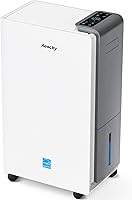
AEOCKY 80 Pint 5,500 Sq Ft Dehumidifier
9.2/10 our score
See it on Amazon -
3

- 4
 Best for quiet bedroom-level basementsCheck it
- 5
 Check it
AEOCKY 5000Sq.Ft Energy Star Version 6.0 Dehumidifier
Best value for a damp basement - 6
 Check it
Waykar 120 Pint 6,000 Sq Ft Dehumidifier
Best for a soaking wet basement - 7
 Check it
VEAGASO 34 to 36 Pint Dehumidifier
Best for medium damp on a budget - 8
 Check it
Kesnos 150 Pint 7,500 Sq Ft Dehumidifier
Best for commercial-size basements - 9
 Best for a small basement roomCheck it
The best dehumidifiers for a 1,200 sq ft basement
The ToLife wins on fit and quiet for a tight basement room, while the AEOCKY 80 pint handles the open floor. Every other pick earns its place by solving one specific need, from Wi-Fi control to commercial-scale damp.
ToLife Dehumidifier: Best for tight basement corners
- Rated to 1,000 sq ft
- 95 oz tank
- Sleep mode under 30 dB
- Auto shutoff when the tank is full
A compact thermoelectric unit with a full 95 oz tank and a quiet sleep mode, sized for a closed basement room rather than an open 1,200 sq ft floor.
Pros
- Very small footprint
- Quiet sleep mode under 30 dB
- Full-tank auto shutoff
- 7-color light can be locked
Cons
- Rated to 1,000 sq ft, below a full 1,200 sq ft floor
- Thermoelectric cooling removes less water than a compressor
The ToLife is the best fit for a 1,200 sq ft basement that is really a set of smaller rooms. It's rated to 1,000 sq ft, so it suits a laundry corner, a storage room or a finished nook rather than a wide open floor.
Its 95 oz tank means fewer trips to empty it, and the full-tank auto shutoff stops the unit before water can spill. A sleep mode keeps noise under 30 dB, which matters if a guest room or home office sits next to the basement stairs.
It weighs 2.66 kg, so moving it between rooms is easy.
The 7-color light is a small extra you can lock to one shade. Two speeds give you a powerful setting for a damp week and a quiet one for the rest of the time.
ToLife notes the unit suits small spaces such as bedrooms and bathrooms, so treat it as a room solution. The trade-off is coverage: at 1,000 sq ft it leaves part of a 1,200 sq ft floor to a second unit or to better air circulation.
AEOCKY 80 Pint 5,500 Sq Ft Dehumidifier: Best overall for a wide open basement
- 80 pint/day capacity
- Rated to 5,500 sq ft
- ENERGY STAR Most Efficient 2025
- 44 dB on low
A compressor dehumidifier with real headroom for a 1,200 sq ft floor, a 44 dB low fan speed and a drain hose for hands-free water removal.
Pros
- Covers far more than 1,200 sq ft
- Most Efficient 2025 certified
- Drain hose and garden hose adapter included
- Runs at low temperatures without frosting up
Cons
- Large for a narrow corner
- More capacity than many basements need
The AEOCKY 80 pint is the best overall pick when your 1,200 sq ft basement is one open floor. It's rated to 5,500 sq ft, so it has real headroom and won't run flat out to hold humidity.
Its 80 pint daily capacity is measured in hot, humid summer air, and AEOCKY says it drops to 56 pints per day in a warm, damp basement. That's still far more than a typical 1,200 sq ft space needs.
The ENERGY STAR Most Efficient 2025 label matters here, because a basement unit often runs all day.
Auto defrost and low-temperature operation let it keep working as the basement cools. A drain hose and garden hose adapter come in the box, so you can skip the tank.
At 44 dB on low it's quiet for its size, and the humidity chip reacts within milliseconds to keep the level steady. The trade-off is bulk: 14.45 in deep and 24.09 in tall, so measure the spot before you order.
Midea 22 Pint Dehumidifier: Best for Wi-Fi control
- 22 pint/day capacity
- Rated to 1,500 sq ft
- Wi-Fi, Alexa and Google Assistant
- Energy Star certified
A 1,500 sq ft unit with app and voice control, so you can adjust humidity from upstairs without walking down to the basement.
Pros
- Rated above 1,200 sq ft
- App and voice control
- Energy Star certified
- Four wheels for moving it
Cons
- 22 pints per day suits moderate damp
- Hose for continuous draining sold separately
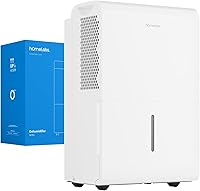
Midea is the pick for anyone who wants to set the humidity without walking downstairs. It's rated to 1,500 sq ft, comfortably above 1,200 sq ft, and removes 22 pints per day.
Wi-Fi control through the SmartHome app works with Alexa and Google Assistant. The humidity setting runs from 35% to 85%, so you can keep a basement at the 45% to 55% comfort range.
Four wheels and handles make it easy to move between rooms, and the 135 cfm airflow pushes air across a small floor.
It's Energy Star certified and Midea says it saves 31% energy against a traditional dehumidifier. The unit stops when the tank is full and restarts after you empty it.
Auto defrost and auto restart add reliability. The trade-off is capacity: 22 pints per day handles moderate damp, not a leaking floor.
A drain hose is also sold separately.
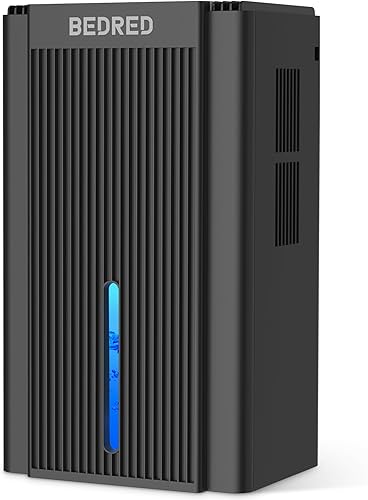
BEDRED Dehumidifier: Best for quiet bedroom-level basements
- Rated to 1,000 sq ft
- 95 oz tank
- Sleep mode with lights off
- 7-color ambient light
A compact thermoelectric unit with a sleep mode that dims the ambient light and quiets the fan, for a finished corner of the basement.
Pros
- Sleep mode turns the light off
- Small footprint
- Full-tank auto shutoff
- Locks in one light color
Cons
- Rated to 1,000 sq ft
- Thermoelectric, so slower on a soaked floor
BEDRED is the quiet pick for a basement corner used as a bedroom or den. It's rated to 1,000 sq ft, so it's best in a closed room within the larger floor.
Sleep mode turns the ambient light off and drops the fan to a whisper. The 7-color light is a nice touch when you want a soft glow, and you can lock one shade.
A 95 oz tank and full-tank auto shutoff keep it safe to leave alone.
It's small, at 6.7 in deep and 14.6 in tall, and weighs 5.8 pounds, so it tucks beside furniture and moves without effort. The trade-off is the same as the ToLife: a 1,000 sq ft rating leaves part of a 1,200 sq ft basement uncovered.
It's also thermoelectric, so it pulls water more slowly than the compressor units here. Pick it when the basement room doubles as living space and you want it quiet and out of the way.
AEOCKY 5000Sq.Ft Energy Star Version 6.0 Dehumidifier: Best value for a damp basement
- 74 pint/day capacity
- Rated to 5,000 sq ft
- ENERGY STAR Version 6.0
- 44 dB on low
The lower-priced AEOCKY of the pair, with 74 pints per day and auto defrost that keeps it running in a cool basement.
Pros
- 74 pints per day
- ENERGY STAR Version 6.0
- Auto defrost for cool rooms
- Drain hose included
Cons
- Slightly less capacity than the 80 pint model
- Single fan speed
The AEOCKY 74 pint is the value pick for a damp 1,200 sq ft basement. It's rated to 5,000 sq ft, so it has plenty of reach, and it runs 74 pints per day in hot, humid air.
AEOCKY says it drops to 52 pints per day in a warm, damp basement. That's still more than enough for most 1,200 sq ft floors.
ENERGY STAR Version 6.0 certification and a drain hose in the box keep running costs and upkeep down.
Auto defrost matters in a cool basement: it detects frost and melts it without shutting the unit down. The low fan speed is 44 dB.
Its 14.4 in depth and 23.3 in height are close to the 80 pint model. The trade-off is capacity: it's slightly smaller than the 80 pint AEOCKY and has a single fan speed.
Pick it when you want a big-basement unit at a lower cost and your damp is steady rather than extreme.
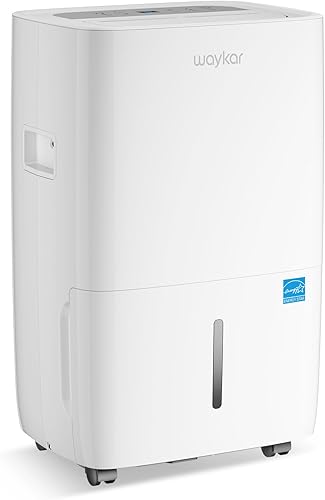
Waykar 120 Pint 6,000 Sq Ft Dehumidifier: Best for a soaking wet basement
- 120 pint/day capacity
- Rated to 6,000 sq ft
- 90° auto swing airflow
- 30% to 80% humidity control
A high-capacity compressor unit for a basement with standing damp or a history of leaks, with a swing airflow that moves dry air around the floor.
Pros
- 120 pints per day
- Humidity control down to 30%
- 90° swing airflow
- Drain hose and 24-hour timer
Cons
- Overkill for a mildly damp 1,200 sq ft floor
- Heavier than the compact picks
Waykar is the pick for a 1,200 sq ft basement with real water problems. It's rated to 6,000 sq ft and removes up to 120 pints per day, so it clears a soaked floor faster than anything else here.
The 30% to 80% humidity range lets you push below the usual 40% floor when you need to dry a crawlspace or a room after a leak. A 90° auto swing airflow moves dry air around the floor instead of straight ahead, covering more of the space with one pass.
It's Energy Star certified and runs at about 42 dB.
A 1.14-gallon tank and an included 3.3 ft drain hose give you both drainage options, and the hose fits a standard 3/4 in garden connection. A 24-hour timer lets you schedule it.
The trade-off is size and weight: at 120 pints per day it's more capacity than a mildly damp floor needs, and at 34 pounds it's heavier than the compact picks.
VEAGASO 34 to 36 Pint Dehumidifier: Best for medium damp on a budget
- 34 to 36 pint/day capacity
- Rated to 2,500 sq ft
- Three modes
- Sleep mode at 38 dB
A mid-capacity compressor unit rated well above 1,200 sq ft, with a drain hose and a sleep mode for a basement you use in the evening.
Pros
- Rated to 2,500 sq ft
- Drain hose included
- Sleep mode at 38 dB
- Runs on R290 refrigerant
Cons
- Smaller tank than the high-capacity models
- Fewer fan speeds than the AEOCKY 80 pint
VEAGASO is the middle option for a 1,200 sq ft basement with moderate damp. It's rated to 2,500 sq ft, so it covers the whole floor without overshooting, and it removes 34 to 36 pints per day.
Three modes cover everyday moisture, faster clothes drying and continuous running for a space that never dries out. A 0.53-gallon tank holds hours of water, and an included drain hose gives you a hands-free setup.
The LED touch panel shows real-time humidity.
It runs at 40 dB or less in low speed, and VEAGASO puts sleep mode at 38 dB. Power failure memory restores your settings after an outage, and the unit keeps working on R290 refrigerant.
The trade-off is tank size: 0.53 gallons is smaller than the high-capacity units here, so the hose matters. Pick it when the basement is damp but not soaked and you want a mid-size unit with a hose in the box.
Kesnos 150 Pint 7,500 Sq Ft Dehumidifier: Best for commercial-size basements
- 150 pint/day capacity
- Rated to 7,500 sq ft
- 2.12-gallon tank
- MIRAGE sleep mode
The largest unit here, built for a 1,200 sq ft basement that behaves more like a commercial space: multiple rooms, constant damp or a big open floor.
Pros
- 150 pints per day
- 2.12-gallon tank
- Humidity control from 30% to 80%
- Memory restart after outages
Cons
- Bigger than most homes need
- Heaviest unit in this group
Kesnos is for the 1,200 sq ft basement that behaves like a commercial space. It's rated to 7,500 sq ft and removes up to 150 pints per day, the largest capacity here.
A 2.12-gallon tank means fewer empties, and the included 3.3 ft drain hose handles continuous drainage. Humidity is adjustable from 30% to 80%, and two fan speeds let you match the setting to the room.
The MIRAGE sleep mode turns the display off while the unit keeps running.
Memory restart restores settings after a power cut, and a safety lock stops accidental changes. A front humidity display shows the current level at a glance, and auto defrost and overload protection keep it reliable.
The trade-off is that it's bigger and heavier than most homes need, at 38.1 pounds. Pick it when the space is a large open basement or a home business area that stays damp year-round.
GoGuess 21 Pint Dehumidifier: Best for a small basement room
- 21 pint/day capacity
- Rated to 1,600 sq ft
- Three modes including Turbo
- 40 dB operation
A low-capacity compressor unit for a 1,200 sq ft basement split into smaller rooms, with a Turbo mode for drying laundry and a child lock.
Pros
- Rated to 1,600 sq ft
- Turbo mode for drying
- Child lock
- Drain hose included
Cons
- 21 pints per day is the smallest here
- 2.3L tank fills quickly without a hose
GoGuess is the small-room pick when your 1,200 sq ft basement is divided into separate spaces. It's rated to 1,600 sq ft and removes up to 21 pints per day.
Three modes cover dehumidifying, a Turbo setting for faster drying and a quiet Sleep mode. The humidity setting runs from 30% to 80%, and the unit switches on when humidity rises and off when it's met.
A 2.3L tank triggers auto shutoff when full, and an included 3.28 ft drain hose gives continuous drainage.
It runs at 40 dB and pulls 80 watts, so it's light on power for all-day use. Sleep mode dims the display.
A child lock adds safety in a family basement. The trade-off is the smallest capacity here: 21 pints per day suits moderate damp in a closed room, and the tank fills quickly without the hose attached.
How we compared these dehumidifiers
We didn't test these units. We compared the specs each brand publishes: rated coverage, daily pint capacity, tank size, drainage options, noise figures and low-temperature operation.
Then we weighed how each one fits a 1,200 sq ft basement.
Our score weighs specs, features and buyer feedback against what you're shopping for. Coverage and capacity carry the most weight, because a unit that's too small for the floor runs nonstop and still loses.
Drainage, noise and defrost come next, since those decide whether you can leave it running for days. Then we looked at physical size, because a big unit that blocks its own airflow in a narrow corner gives up much of its rated performance.
| Product | Best for | Rated coverage | Tank | Size (D x W x H) | Our score |
|---|---|---|---|---|---|
| ToLife Dehumidifier | tight basement corners | 1,000 sq ft | 95 fl oz | 8.27 x 5.55 x 13.78 in | 9.5 |
| AEOCKY 80 Pint 5,500 Sq Ft Dehumidifier | overall for a wide open basement | 5,500 sq ft | 14.45 x 8.66 x 24.09 in | 9.2 | |
| Midea 22 Pint Dehumidifier | Wi-Fi control | 1,500 sq ft | 10.51 x 15.31 x 19.8 in | 8.8 | |
| BEDRED Dehumidifier | quiet bedroom-level basements | 1,000 sq ft | 95 fl oz | 6.7 x 8.7 x 14.6 in | 8.7 |
| AEOCKY 5000Sq.Ft Energy Star Version 6.0 Dehumidifier | value for a damp basement | 5,000 sq ft | 14.4 x 8.6 x 23.3 in | 8.5 | |
| Waykar 120 Pint 6,000 Sq Ft Dehumidifier | a soaking wet basement | 6,000 sq ft | 9.84 x 13.39 x 21.86 in | 8.4 | |
| VEAGASO 34 to 36 Pint Dehumidifier | medium damp on a budget | 2,500 sq ft | 12.5 x 10 x 19 in | 8.3 | |
| Kesnos 150 Pint 7,500 Sq Ft Dehumidifier | commercial-size basements | 7,500 sq ft | 11.73 x 15.47 x 24.57 in | 8.1 | |
| GoGuess 21 Pint Dehumidifier | a small basement room | 1,600 sq ft | 7.2 x 13.2 x 17.1 in | 8.1 |
What coverage rating do you need for a 1,200 sq ft basement?
Buy a unit rated at or above 1,200 sq ft, or split the floor between two smaller units. A single unit rated to 5,000 sq ft or more gives you headroom for humid weeks and a wide open floor.
When a 1,000 sq ft unit is enough
A unit rated to 1,000 sq ft works when the 1,200 sq ft basement is broken into closed rooms. Put it in the dampest one and let it hold that space at 45% to 55% humidity.
The ToLife and BEDRED fit this pattern, and both stay quiet enough for a room you use. ToLife's own guidance points the unit at bedrooms, bathrooms and small rooms rather than whole floors.
When you need a bigger unit
Choose 2,500 sq ft or more when the floor is open or the walls sweat. The VEAGASO at 2,500 sq ft covers the whole floor without overshooting.
The AEOCKY 80 pint and 74 pint go further, which helps when the basement has a leak or a wet season.
How many pints per day does a damp basement need?
A 1,200 sq ft basement usually needs 20 to 35 pints per day for moderate damp. Go to 50 pints or more when the floor stays wet or the air feels heavy all summer.
Matching capacity to how wet the floor gets
A dry basement with a musty smell only needs a small unit. A floor that beads water after rain needs a 50 to 80 pint unit.
A basement that has flooded or has a constant leak needs 120 pints or more. That's why the Waykar and Kesnos sit at the top of the capacity range here.
Why the rating on the box overstates real-world output
Daily pint ratings are measured in hot, humid air. AEOCKY says its 80 pint unit drops to 56 pints per day in a warm, damp basement, and its 74 pint unit drops to 52.
So read the rating as a ceiling, not a promise. A 120 pint unit that runs in a cool basement still moves a lot of water, but less than the box says.
A quick check before you commit
Look at the conditions your basement actually sees. A cool, partly finished cellar in spring runs closer to the basement figures than the summer ones.
If you're choosing between two sizes, pick the larger only when the smaller would run nonstop. Running a unit continuously costs more energy than sizing up and letting it cycle.
Do you need a drain hose in a basement?
Yes, if you plan to run the unit for days without checking on it. A drain hose sends water to a floor drain or sink and lets the unit run continuously.
Units with a hose in the box
The AEOCKY 80 pint and 74 pint include a drain hose and a garden hose adapter. So do the Waykar, VEAGASO, Kesnos and GoGuess.
That makes any of them a set-and-forget option in a damp basement. The ToLife and BEDRED rely on their 95 oz tanks.
When a tank is fine
A tank works when the unit runs a few hours a day or the basement stays mildly damp. A 95 oz tank holds roughly six pints, so it fills within days in a damp room.
Kesnos offers a 2.12-gallon tank as a middle option. If you'll run the unit all summer, the hose is worth having.
Will a dehumidifier work in a cold basement?
Compressor units lose efficiency as the room cools, and some frost up and stop. Look for auto defrost and a stated low-temperature range if your basement stays cool.
Compressor units with defrost
The AEOCKY 80 pint and 74 pint use auto defrost and are rated to keep running in cool rooms. The Waykar and Kesnos also have auto defrost.
These are the picks for an unheated basement that dips below 65°F in winter.
Thermoelectric units in cool rooms
The ToLife and BEDRED use thermoelectric cooling. That design is quiet and simple, but it pulls less water as the room cools.
ToLife itself notes the unit works best when the air is above about 42% humidity and the doors and windows are closed. They suit a heated basement room, not a cold, open cellar.
Should you pick a compressor or a thermoelectric dehumidifier?
Pick a compressor unit for a large or wet basement. Pick a thermoelectric unit for a small, closed room where quiet matters more than speed.
Compressor units for big and wet floors
Compressors move more water per day and hold efficiency better. Every big pick here is a compressor: the AEOCKY pair, the Midea, Waykar, VEAGASO, Kesnos and GoGuess.
For a 1,200 sq ft open floor, this is the right type.
Thermoelectric units for small quiet rooms
Thermoelectric units are compact and quiet. The ToLife and BEDRED both use this design and run in sleep mode.
They fit a bedroom or den corner inside the larger basement, not the whole floor.
Which dehumidifier fits your basement layout?
Measure the spot before you choose. A big unit in a narrow corner blocks airflow and loses efficiency.
Open floor with a wide spot
The AEOCKY 80 pint or Waykar fits an open floor. Give either unit room to breathe.
The Waykar's 90° swing airflow helps in a wide space. The Kesnos is the largest option if the floor is very big or very wet.
Tight corner or closed room
The ToLife and BEDRED are the smallest units here. The ToLife is 8.27 in deep; BEDRED is 6.7 in deep.
Either fits beside shelving or under a workbench. Pair one with a second unit for the rest of the floor if needed.
Verdict
For most 1,200 sq ft basements, the ToLife Dehumidifier is the best pick, because it's compact, quiet and easy to leave running in a corner. Buy the AEOCKY 80 pint instead when the floor is wide open or the walls stay damp: its 80 pint capacity and 5,500 sq ft rating give you room to spare.
If the basement is a single closed room, a 1,000 sq ft thermoelectric unit is enough. If it's an open floor or has a leak, go to 2,500 sq ft or more.
For steady damp without extreme water, the VEAGASO is the middle ground. For a space that behaves like a commercial floor, the Kesnos 150 pint covers it.
If quiet is your main concern, BEDRED is the calmest small pick.
One last check: if your basement is finished living space, read our finished basement picks before you buy. And if you want to see how a bigger unit performs in a large open floor, the hOmeLabs review covers one option in detail.
Our top 3 picks at a glance
-
1
-
2
Best overall for a wide open basement
AEOCKY 80 Pint 5,500 Sq Ft Dehumidifier
9.2/10 our score
See it on Amazon -
3
Frequently asked questions
Do I need a drain hose in a basement?
A drain hose is the easiest way to keep a dehumidifier running for days without emptying a tank. Most large units here include one; the Midea needs a standard hose bought separately.
Will a dehumidifier work in a cold basement?
Compressor units lose efficiency as the room cools and can frost up. The AEOCKY models use auto defrost and are rated to keep running in cooler rooms; a thermoelectric unit loses more capacity in the cold.
How often should a basement dehumidifier run?
In a damp basement, many people run one continuously during humid months and switch to a humidity setting in drier weeks. A target of 45% to 55% relative humidity is a common comfort range.